
Applicant Tracking Systems Basics
No matter who you are, where you are from, what your profession is, you can’t escape the process of the job search. Everybody uses different methods to get that desired position. But one step in the long process remains stable: you need to submit your resume online or via email and undergo the scanning by applicant tracking systems (ATS).
A brief history of Applicant Tracking Systems
To better understand the role of ATS and its function, let’s have a look at the following infographic. It describes the evolution of the modern ATS.
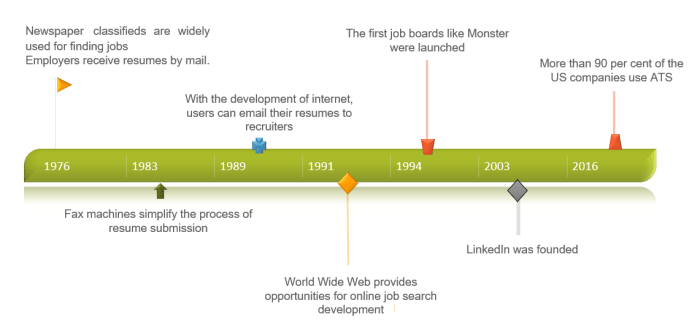
Applicant Tracking Systems: features and functioning
An applicant tracking system (ATS) is a special software that determines whether the information in your resume corresponds to the job ad. It helps to organize the hiring process, starting from importing job applications to the system up to sending offer letters. Recruiters can manage to speed up the procedure and stay organized as the process is entirely automated.
The most famous ATS are Taleo, Brassring, iCIMS, Greenhouse.
Modern ATS have various features, including
- Resume importing
- Resume parsing
- Applicant tracking
- Video interviewing
- Interview scheduling
- Offer letter management
- Mobile app
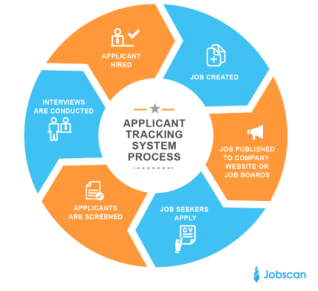
The functioning of the ATS has the following steps:
- You submit an online resume application.
- Your resume is imported into the ATS.
- The system extracts the information from your resume (resume parsing).
- The system organizes your information into categories such as skills, education, work experience, contact information.
- Recruiter searches ATS by keywords. These are the words that a job post contains.
- Recruiters view the resumes with matching keywords.
- If the screening is successful, the interview is scheduled using ATS.
Applicant Tracking Systems: pros and cons
Applicant tracking systems have become an essential part of the recruiting procedure. And like any technology, they have their benefits and drawbacks.
The benefits of ATS are as follows:
| For the recruiter | For the job candidate |
| · Streamlining the process (many resumes can be processed in a short period)
|
· Mobile-friendly (can apply anywhere, anytime) |
| · Providing database storage (a pool of candidates is available instantly) | · Save time (possibility to upload information directly from LinkedIn and Indeed) |
| · Saving time and money (one person can deal with several job openings simultaneously)
|
|
| · Provide recruitment analytics (it helps develop a hiring strategy) |
The drawbacks of the ATS usually relate to technical issues. Some systems can’t read the submitted resume. It happens because its layout differs from the one the system is programmed to understand.
Another problem can occur when the candidate doesn’t insert appropriate keywords into a resume. ATS eliminates it without further consideration. This leads to the possible throwing out of highly skilled candidates.
Is there a future for Applicant Tracking Systems?
Finding talented candidates remains the primary issue for hiring managers. This results in the further development of ATS. The newest models show a gradual integration with Artificial Intelligence (AI). Its algorithms can improve the selection process, which now relies mostly on resumes and interviewers’ opinions.
Another wave of development involves the integration of Candidate Relationship Management (CRM) technology with ATS. Thanks to this technology, employers can track the website and social network activities of a candidate. Using this information, they can choose the candidate who fits the best.
In a short period of time, the high technologies are far from ousting humans from the hiring process. But with further development and increasing demands, ATS systems are here to stay. Job candidates just need to find a way to befriend them.

 Oksana Chetveryk