What is Plain Language and How to Benefit from It
Forget everything they taught you about writing. From now on, you are not going to deliver boring, cluttered, wordy messages, because you are on your way to use plain language.
No matter what your education is, where you live and what your career path is, a clear and simple message can help you advance in your professional life. Busy colleagues and employers would be happy to receive an email or any other business document, which is easy to read and understand as it saves their time and efforts.
Evolution of writing is around the corner
While at school, college or university, you might have done a lot of writing on different topics. So, now you consider yourself an expert in writing. However, I would suggest rethinking your writing experience as the business world is all about time and efficiency. And as we are slowly moving from Homo Sapiens to Homo Digitalis, who is likely to switch to online communication only, plain language writing is inevitable to succeed in any field.
Mechanics of plain language writing
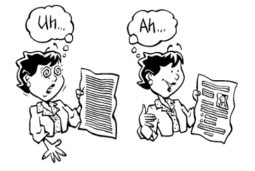
The plain language is contemporary writing, which is easy to understand from the first time you hear or read it. This writing has the following features:
- Simple, short, everyday words;
- Minimal adjectives and adverbs;
- Action-oriented verbs in the present tense;
- No jargon, clichés or unexplained abbreviations;
- Short sentences between 15 to 20 words for business writing; 1 to 12 words for online;
- Short paragraphs;
- Easy-to-read layout.
Bear in mind to choose the right tone for your message depending on your target audience. In most cases, a conversational tone would fit the most.
Reap the benefits
Learning to write simply and briefly might be difficult at the beginning, but you are bound to get a bunch of benefits such as:
Readers can easily understand your message.
Writing in plain language is reader-friendly and clear. As a result, you avoid misunderstanding and save yourself time and energy.
You can reach more people.
You can increase the diversity of your audience, including the readers with literacy difficulties. Because simpler messages will help them to understand the content faster and they are likely to respond to you back.
You can produce a positive impression even before the first meeting.
Your communication style is your first step to stand out and produce a positive image on your colleagues, business partners or employers. Consequently, when you meet for the first time, you will have, at least, one bonus in store.
Your writing becomes time effective.
Accessible and direct messages, which are quick to read and respond, show that you value the time of your readers. This helps to build trust and closer connections for future cooperation.
You are confident in what you read.
If you express your thoughts in a concrete and simple way, you can be sure that the message you write communicates the necessary information. And as a result, it is easy to read and understand your thoughts and ideas.
As soon as you begin writing in plain language, you will see how simple and clear your message can be. And, as you know, choosing reader-friendly communication is an excellent way to make new meaningful contacts, reach potential customers and be noticed by prospective employers.
The faster you will start your language transformation, the better your message will come across. Let your language be plain!

 Oksana Chetveryk